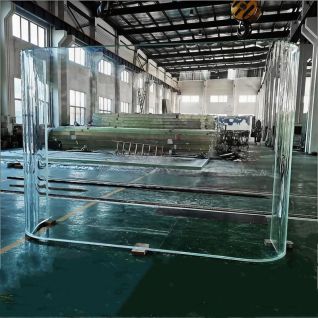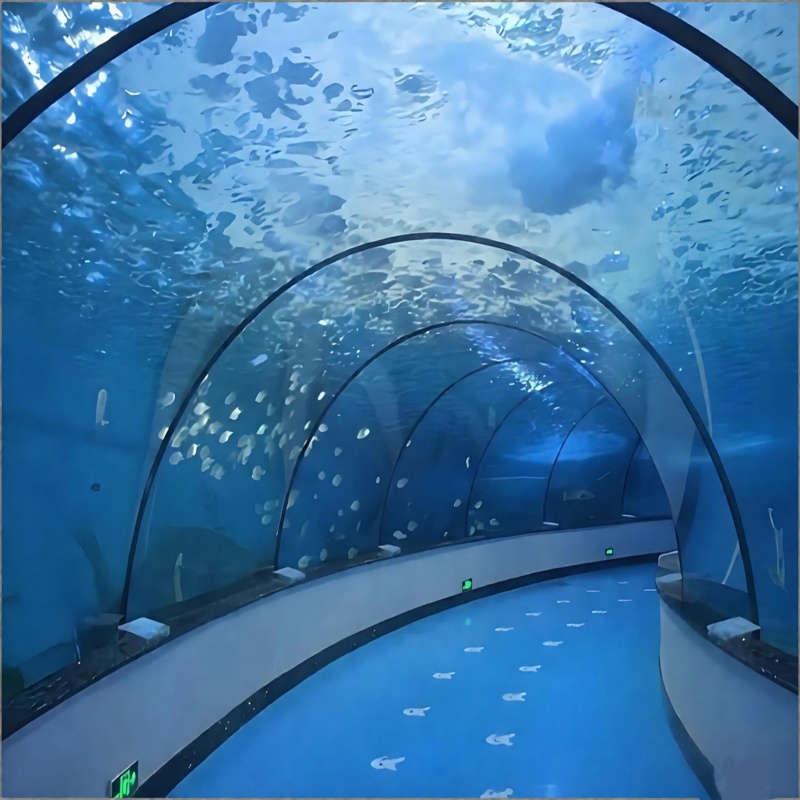
Large Acrylic aquarium tunnel made from engineering-grade cast acrylic panels. Features 270°–360° panoramic viewing, seamless bonding, ≥93% light transmittance, and 10x impact resistance of glass. Ideal for oceanariums, theme parks, shopping malls, and commercial projects. Any size, shape, and curvature available. Get a quote.
We provide full-chain services from panel production, structural design, thermoforming, seamless bonding, to on-site installation guidance. Custom sizes, shapes, and curvature are available according to project drawings.
Core Selling Points
1. 270°–360° Panoramic Viewing, Ultimate Immersion
The arched or circular design, combined with high-transparency acrylic panels (light transmittance ≥93%), creates a nearly invisible barrier between visitors and the underwater world. Fish appear to swim in mid-air, offering a truly immersive experience.
2. One-Piece Thermoforming, Seamless Curved Surface
Thick acrylic panels are heated and thermoformed into precise arcs. Curved sections require no splicing, avoiding joints and stress concentration. The tunnel surface remains continuous, smooth, and visually flawless.
3. Bulk Polymerization Seamless Bonding, No Leakage
Joints between panels use bulk polymerization fusion bonding. Joint strength reaches over 80% of the original panel, and joints are virtually invisible. The entire tunnel acts as a continuous structure, eliminating leakage risks at the source.
4. High Pressure Resistance, Safe and Reliable
Acrylic impact resistance is more than 10 times that of ordinary glass. It cracks but does not shatter, with no risk of flying fragments. The arch structure evenly distributes water pressure, allowing the tunnel to withstand hundreds of tons of water load safely.
5. Lightweight Design, Reduced Structural Load
Density is only 1.19–1.20 g/cm³, about half that of glass. This significantly reduces the load on supporting steel structures and makes large-span tunnel designs easier to realize.
6. UV-Resistant, Durable, Easy Maintenance
Built-in UV-resistant formula ensures no yellowing or embrittlement for 20–30 years. Minor surface scratches can be polished on site without draining the water or replacing panels.
7. Free Customization for Any Project
Supports arch, circular, semi-circular, 360° panoramic, and freeform designs. Panel thickness ranges from 20–500 mm. Maximum single panel size is 9980 × 3050 mm. Larger sizes can be achieved through seamless bonding.
Special Design Considerations for Aquarium Tunnels
1. Structural Design
The arch or circular cross-section is used to evenly distribute water pressure across the curved surface, avoiding stress concentration. Structural calculations must consider water depth, tunnel span, panel thickness, and safety factors (typically 6–8 times).
2. Seamless Bonding
Multiple panels are joined using bulk polymerization fusion bonding. The joint strength reaches over 80% of the original panel. Joints are visually nearly invisible, ensuring both structural integrity and visual continuity.
3. Waterproofing
All joints and connections must be fully sealed. The tunnel is subjected to a full water test before delivery to ensure no leakage under long-term water pressure.
4. Lighting Integration
LED lighting can be integrated into the tunnel structure to enhance the underwater atmosphere. Lighting should be evenly distributed to avoid glare or dark spots.
5. Safety Features
Anti-slip flooring, emergency exits, and handrails can be integrated into the tunnel design. Acrylic panels are impact-resistant and will not shatter into dangerous fragments.
6. Maintenance Access
Design should include access points for cleaning and polishing the acrylic panels. Surface scratches can be polished on site without draining the water.
Application Scenarios
Oceanariums & Aquariums: Underwater viewing tunnels for marine life observation.
Theme Parks: Immersive underwater walkways as a major attraction.
Shopping Malls: Large acrylic tunnels as a commercial display and photo spot.
Hotels & Resorts: Underwater tunnels connecting different areas or as a luxury feature.
Museums & Exhibition Centers: Transparent tunnels for underwater or themed exhibitions.
Zoos & Wildlife Parks: Aquatic tunnels for observing marine and freshwater species.
Jiangsu Xitu Acrylic Materials Co., Ltd. is located in Yancheng, Jiangsu Province, with a registered capital of RMB 10 million. The company covers an area of approximately 40 mu and has a professional team of more than 100 employees, with an annual production capacity exceeding 2,000 tons ....[ Read More >>]